Start with the RTP split
The key distinction is 89.62% base RTP versus up to 93.12% effective RTP when boosters contribute. Do not compare this game to 96%+ slots without accounting for that lower base return.
A live race game from 155.io where 106 physical ping-pong balls cascade down a ten-step staircase; the first ball into the funnel decides the payout. Stair Pong Editorial Team reads the numbers from the in-game interface, separates base RTP from booster-influenced RTP, and explains what the data says about expected value, variance, and the 10.38% house edge.
Before treating Stair Pong as a playable option, use the five checks below to separate the visible 106-ball race from casino offer language.
The key distinction is 89.62% base RTP versus up to 93.12% effective RTP when boosters contribute. Do not compare this game to 96%+ slots without accounting for that lower base return.
White and orange resolve more often with smaller payouts; green, blue and pink create larger swings. The expected value is negative for every colour, so stake size matters more than colour preference.
Check that the live lobby shows the 106-ball race, ten-step staircase and one-ball funnel result. If a casino page shows a different mode or missing rules screen, treat its numbers as unverified.
Lightning Rounds, streak multipliers and level boosts can change effective RTP, but they do not turn every round positive value. Read their trigger conditions before counting them in a session plan.
Before taking a casino offer, confirm Stair Pong contribution, max-bet limits, withdrawal review and country access. Operator terms override any affiliate guide once you open an account.

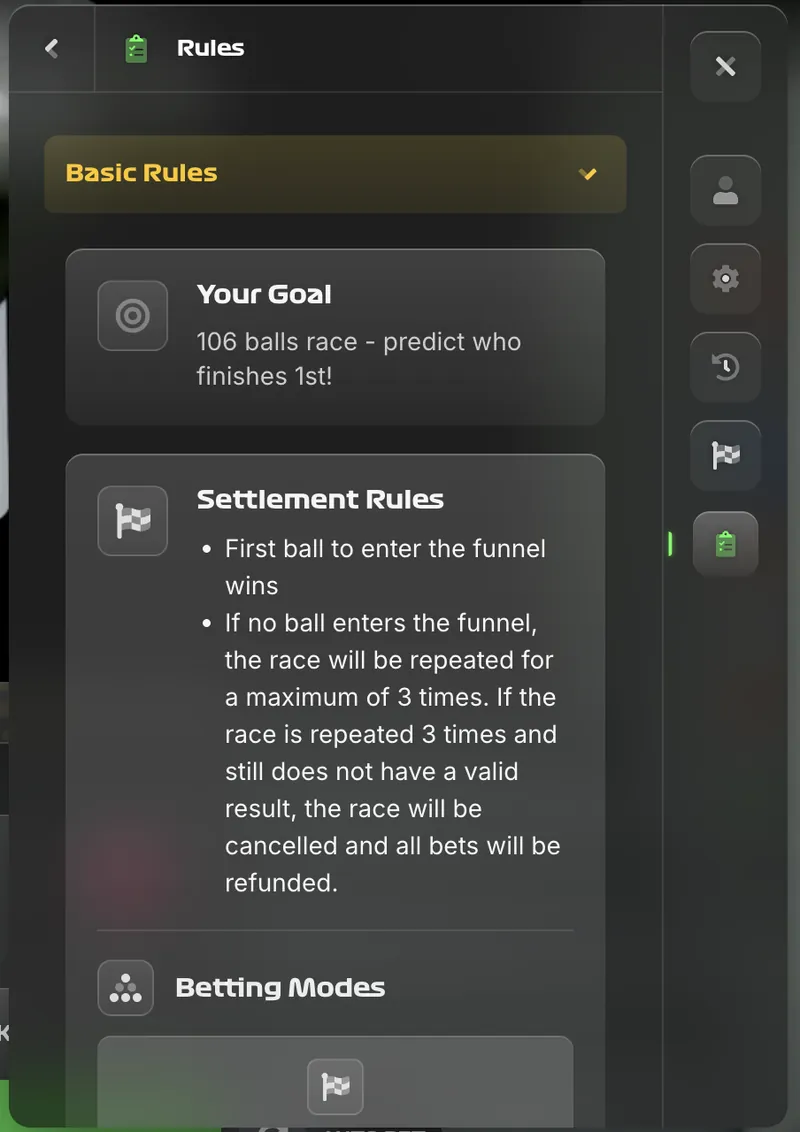
One Stair Pong round takes roughly 65 seconds from bet open to payout. Every race is a real physical event filmed in 155.io's London studio, not a random-number generator. The data that follows comes directly from the in-game rules screen and was cross-checked against the Dolby OptiView broadcast feed.
A Stair Pong race begins when 106 numbered ping-pong balls drop onto the top of a ten-step staircase. The balls are distributed by colour in a ratio of roughly 50 white, 40 orange, 10 green, 5 blue, and 1 pink — a split that determines the observed payout multipliers. The single pink ball maps to the top multiplier of 95.95x; the 50 white balls, each almost three times more likely to reach the funnel first, pay 1.91x. A narrow funnel at the foot of the staircase accepts exactly one ball, and that colour resolves every wager placed on the round.
The game's settlement rule handles edge cases cleanly: if no ball enters the funnel within a single race, the race repeats up to three times. After three unsuccessful attempts the round is cancelled and every stake is refunded. The rule is printed inside the in-game interface and is automatically enforced by the operator — players do not need to claim the refund manually.
The fourth phase is the only one a player can genuinely optimise — everything before it is a public probability distribution. For the sequence-by-sequence walk-through, see the full Stair Pong rules and interface guide.
Stair Pong publishes two return-to-player figures, which frequently confuses external review sites. The authoritative source is the in-game RTP screen, captured below.
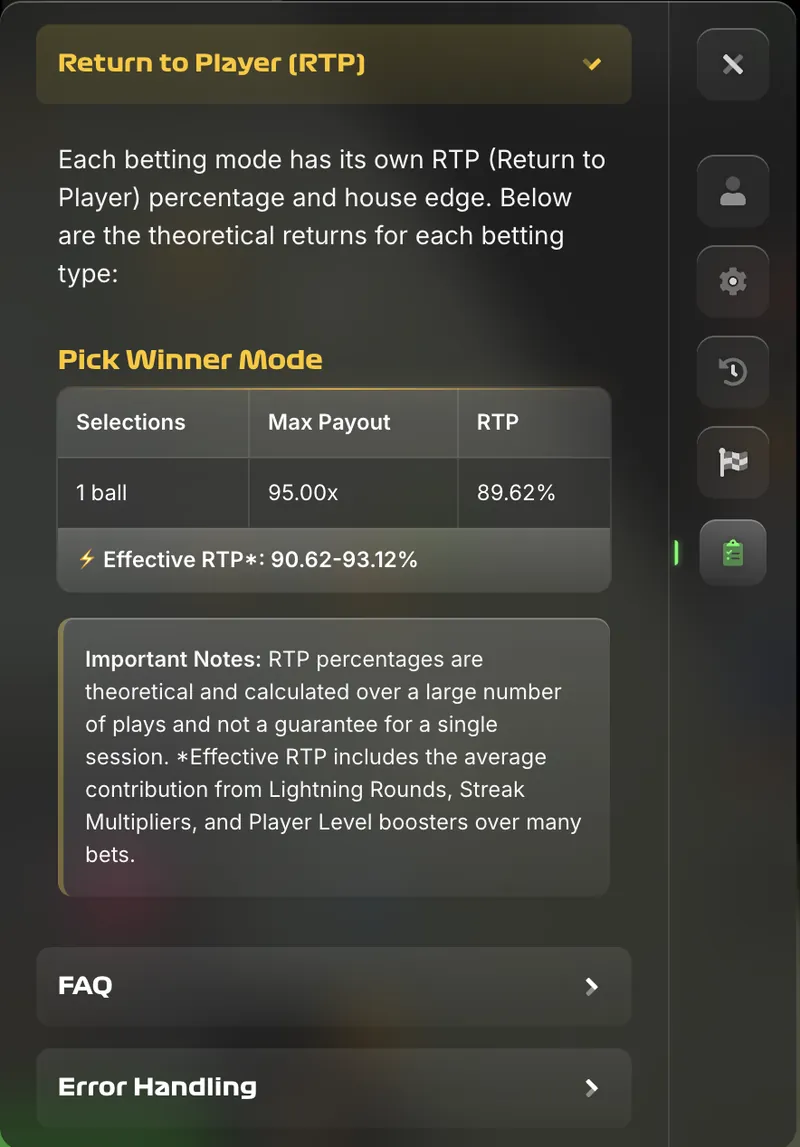
The base return-to-player for the Pick Winner mode with a single ball selected is 89.62%. This figure is theoretical: it describes the expected return across an arbitrarily large number of settled rounds, independent of booster activity. The house edge derived from this base — 10.38% — is the sum that the operator retains on long-run averages.
The effective RTP sits between 90.62% and 93.12%, depending on how often a player's session is touched by Lightning Rounds, Streak Multipliers, and the Player Level system. The interface explicitly states that "effective RTP includes the average contribution from Lightning Rounds, Streak Multipliers, and Player Level boosters over many bets." This is not a guaranteed session result — it is a time-weighted average across active players.
External review sites occasionally quote 94.33% or 94.34% (see for example slotcatalog.com and deadspin.com). These figures likely describe a different betting mode or average across booster participation at a higher saturation than the in-game screen reports. When the numbers diverge, the in-game screen is the authoritative source because it comes from the provider's live UI rather than third-party aggregation.
Every figure on this page was lifted directly from the in-game interface on 18 April 2026 and compared against public statements from 155.io, Dolby OptiView, and the three largest affiliate reviews. Full source list in the methodology section.
Every ball colour shares the same expected value by design — the house edge is flat across the multiplier spectrum. What differs is variance: the cost of occasional enormous wins in terms of frequent small losses. The probability column below derives from the published multiplier and the 89.62% base RTP.
| Colour | Ball count | Multiplier | Implied probability | EV per £10 stake |
|---|---|---|---|---|
| White | ≈ 50 | 1.91x | 46.92% | −£1.04 |
| Orange | ≈ 40 | 2.39x | 37.50% | −£1.04 |
| Green | ≈ 10 | 9.59x | 9.35% | −£1.04 |
| Blue | ≈ 5 | 19.19x | 4.67% | −£1.04 |
| Pink | ≈ 1 | 95.95x | 0.93% | −£1.04 |
The EV column reads identically down every row: a £10 stake on any colour loses £1.04 in expectation, which is the 10.38% house edge applied to the stake. The meaningful tradeoff is session shape. Betting White produces many small wins and losses with low standard deviation; Pink concentrates almost all of the expected return into one very rare win, raising standard deviation dramatically. Players who prioritise session longevity should anchor on White or Orange; players who prioritise a shot at the ceiling should concentrate on Pink and expect to lose frequently.
The interactive Monte Carlo simulator on the strategies page visualises 10,000 rounds of each profile; the variance chart plots standard deviation against session length.
Four permanent mechanics lift the effective RTP above the 89.62% base figure. Each contributes a different expected percentage, stacks with the others, and costs nothing beyond continued play.
Random rounds with boosted multipliers. Rarity scales from Common to Legendary. A Legendary Lightning Round can multiply an already-winning colour by a further factor, measurably lifting the realised RTP during active play.
Consecutive wins increase a session multiplier that applies to the next settled wager. A symmetrical comeback boost triggers after a defined losing streak, softening drawdown.
A single login per twenty-four hours yields a multiplier boost or free-bet credit. The reward stacks with other bonuses rather than replacing them, which is unusual among 155.io portfolio games.
Every wager accumulates experience points. Reaching a level threshold unlocks a permanent multiplier boost, so returning players carry a measurable edge over brand-new accounts.
For the bonus-combined recalculation and an interactive effective-RTP widget that accepts individual booster toggles, see the bonuses page. Players who plan their sessions around Lightning Rounds should also review the strategy adjustments we recommend for volatile booster schedules.
Stair Pong is distributed through a growing list of regulated operators. Availability depends on player jurisdiction, licensing, and 155.io's direct distribution partnerships.
Confirmed carriers as of April 2026 include Stake, Roobet, 1Win, Pin-Up, LuckyStar, Drip, Betsson, Shuffle.com, Dafabet, and Betika (Africa). Licensing usually sits under Curacao eGaming, the Malta Gaming Authority, or the Kahnawake Gaming Commission; jurisdictions without a recognised regulator for 155.io are geoblocked at the operator level.
This review site maintains a single vetted partner link rather than a casino directory, because a rotated seven-operator comparison table typically benefits affiliate commission more than it benefits the player. The partner we recommend has active licensing, published bonus-wagering terms below industry median, and observable Stair Pong availability during our testing period. Readers outside the partner's accepted jurisdictions should check the bonuses page for an independent payment-method and wagering breakdown.
Licensing does not equal safety. Before depositing, confirm the operator accepts your local payment rails, that deposit and session limits are user-configurable, and that self-exclusion is available through GamStop (UK) or the equivalent programme in your jurisdiction.
This Stair Pong review keeps the 106-ball race setup, color EV, RTP context, simulation notes and max multiplier ceiling separate from casino offer language. The math should stay visible before the partner route.
Before real play, confirm the exact 155.io title, local access, stake limits, bonus terms and withdrawal rules. Operator terms outrank any guide note once an account is opened.
Stair Pong earns a 3.8 out of 5 in our math-first rubric. The physical-race format is genuinely novel — verifiable fairness through live broadcast is structurally stronger than the cryptographic "provably fair" claims common across crash games. The multiplier ladder is clean, the RTP screen is honest, and the settlement logic handles edge cases without dispute.
Where Stair Pong loses points is the 10.38% base house edge, which sits noticeably below the 96% RTP that characterises higher-quality slot content. A player running 1,000 rounds at £1 stake should expect a £104 loss on average, with a standard deviation that depends on colour choice. Aggressive Pink concentration can produce a net positive session, but the probability of doing so across 1,000 rounds is roughly 38% — the expected shape of the distribution is loss-heavy with a fat upside tail.
Stair Pong is recommended for players who explicitly value the entertainment of watching a real physical race, who cap their session stakes at 1% of bankroll, and who understand that the in-game boosters shift the effective RTP by a measurable but sub-5% amount. It is not recommended for players chasing variance-maximising bankroll growth; the game's ceiling is not high enough to justify that framing.
For the mathematical details that inform this verdict — the EV table, Monte Carlo equity curves, variance across session lengths, and a Kelly-criterion sizer that quantifies the recommended stake as a percentage of bankroll — step into the full strategies analysis. The mechanics walk-through covers the interface in greater depth; the bonuses page calculates the effective RTP with your specific booster selection live.
The in-game interface confirms 89.62% base RTP for the Pick Winner mode with a single ball selected. Effective RTP rises to between 90.62% and 93.12% once Lightning Rounds, Streak Multipliers, and Player Level boosters contribute to long-run returns. External sites quoting 94.33% appear to average across booster activity or reference a different betting mode; the 89.62% figure is directly sourced from the in-game RTP screen.
Every round uses 106 physical ping-pong balls distributed across five colours: approximately 50 white, 40 orange, 10 green, 5 blue, and 1 pink. The ball colour determines the payout multiplier — White 1.91x, Orange 2.39x, Green 9.59x, Blue 19.19x, Pink 95.95x — and the theoretical win probability follows from the multiplier and base RTP.
Stair Pong is a real physical event. 155.io operates a dedicated studio in London where 106 physical balls are released onto a 10-step staircase and filmed live via Dolby OptiView. Players watch the actual race rather than a computer-generated animation, which makes every outcome visually verifiable.
Expected value is identical across every colour: −£1.04 per £10 stake. This equals the 10.38% house edge applied to the stake. Variance, not expected value, distinguishes the colours — White and Orange produce frequent small outcomes, Pink produces rare large wins offset by frequent losses. Use the EV calculator to reproduce the arithmetic for any stake size.
Classical Kelly produces a negative sizing recommendation for every Stair Pong colour because the house edge is strictly negative. Kelly therefore recommends a zero stake under pure mathematical optimisation. Players who accept entertainment value should cap exposure at 1% of bankroll per round and treat session losses as the cost of live-game access. The Kelly sizer shows this arithmetic live.
155.io streams Stair Pong rounds using Dolby OptiView (formerly Dolby.io Millicast) real-time broadcasting. The platform delivers sub-second latency to mobile devices, which explains the near-instant round settlement across regions. The provider broadcasts 24/7 from its London studio.
Confirmed operators include Stake, Roobet, 1Win, Pin-Up, LuckyStar, Drip, Betsson, Shuffle.com, Dafabet, and Betika. Availability varies by jurisdiction and licensing. This review site maintains a single vetted partner link — confirm licensing (Curacao, MGA, or equivalent) and deposit-limit controls before funding an account.
Martingale doubles the stake after every loss to recover all prior losses on the next win. Applied to White (win probability 46.92%), a seven-loss streak occurs with probability of roughly 1 in 86 and requires a 128-unit bet to recover. Table limits or bankroll caps reach first — Martingale accelerates ruin for players facing a 10.38% negative edge, it does not overcome it. See the full critique on the strategies page.
106 balls, 10 steps, 65-second rounds. Every phase, every settlement rule.
OpenPer-colour expected value, variance chart, Monte Carlo simulator.
OpenWelcome offers, wagering, 8 payment methods. Live booster recalculator.
OpenDemo portal, four drills, pre-flight checklist before real money.
OpenKYC steps, account checks, and the limits to set before a live 106-ball session.
OpenThe August 2026 review keeps the physical-race explanation, probability table and booster notes aligned around one point: visible live mechanics do not remove the base 10.38% house edge. The 106-ball race is transparent because viewers can watch the balls move down the staircase, but the colour distribution still defines the probability map.
A useful practice routine is to watch several demo races without betting and compare the first ball result with the colour count on the table. That makes the payout logic easier to understand before money is involved. Boosters may improve effective RTP, but they need separate trigger checks and should not be treated as guaranteed session value.